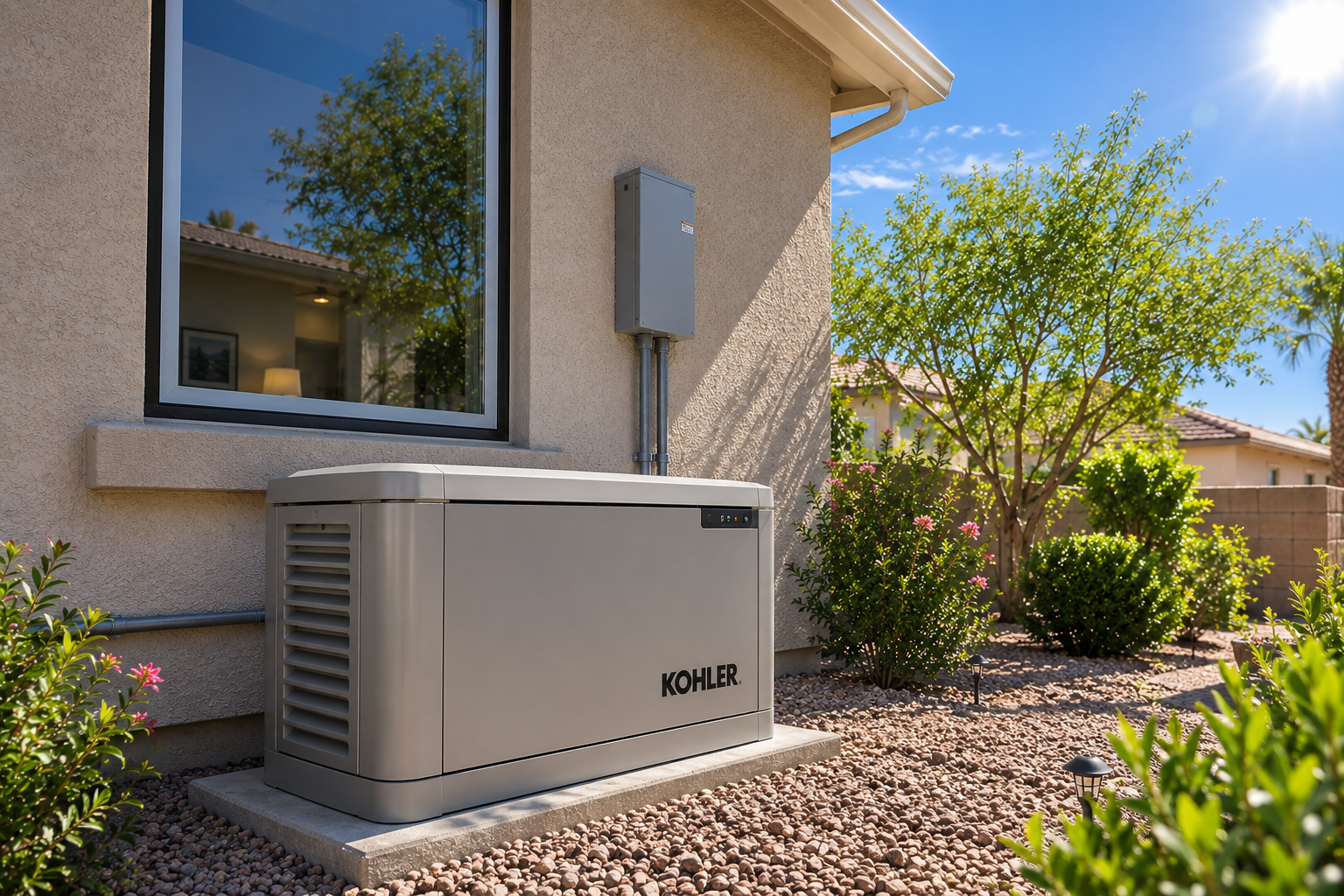
You already know a power outage in Phoenix is more than an inconvenience — the summer heat and monsoon storms make that obvious. This guide is about the next step: how to choose and buy the right standby power generator for your Phoenix home, so you’re not guessing on size, fuel, or cost when you request a quote.
First, Why Phoenix Is a Demanding Place for Backup Power
Phoenix puts unique stress on both your home and any generator you install:
- Monsoon storms cause sudden outages. From June through September, microbursts and dust storms can bring down lines with little warning — the classic Phoenix blackout scenario.
- Extreme heat turns an outage into a safety risk. With no AC, a closed-up home heats fast on a 110°F+ afternoon, which is dangerous for kids, older adults, and pets.
- Record grid demand increases outage risk. As the largest city in the state, Phoenix drives peak-summer load on APS and SRP service territories, raising the odds of interruptions when cooling demand is highest.
In Phoenix, a generator must reliably carry your air conditioning in serious heat. That single requirement drives almost every decision below. Quality standby units are rated to run in temperatures up to 120°F, so the equipment itself can handle the environment when properly selected and installed.
Step 1: Get the Size Right
The most important — and most commonly missed — decision is generator size, measured in kilowatts, or kW. In Phoenix, sizing is really a question of how much cooling you need to run during an outage.
- Essential circuit coverage keeps a few key things on, such as a refrigerator, some lights, outlets, and maybe one AC zone.
- Whole-home coverage runs everything, including central AC across the house.
The right answer comes from a load calculation, not a rule of thumb. Arizona Backup Power looks at your central AC system, multiple AC units if present, essential appliances, medical equipment, pool or well pumps, and the circuits you want covered. Then we size a unit that can carry those needs comfortably in peak heat.
An undersized generator that can’t hold your AC is the one mistake you don’t want to make in Phoenix.
Step 2: Choose Your Fuel: Natural Gas or Propane
Both natural gas and propane work well across the Valley:
- Natural gas taps your existing gas line for an uninterrupted fuel supply, with nothing to refill. It is ideal during extended outages.
- Propane is the answer for homes without natural gas service and stores reliably on-site.
Your property usually points clearly to one option. We confirm fuel availability and installation requirements during the assessment.
Step 3: Pick Your Brand: Generac or Kohler
As an authorized dealer for both Generac and Kohler, Arizona Backup Power installs two of the strongest standby generator brands available:
- Generac is the best-selling home standby brand in North America, with a wide size range, fuel flexibility, quiet operation, and excellent smart monitoring.
- Kohler brings nearly a century of engineering heritage and is prized for durability, seamless integration, and low-profile units that suit upscale homes.
Both include an automatic transfer switch that starts the generator within seconds of an outage and shuts it off when utility power returns — no action needed on your part, even if you’re away.
Step 4: Understand the Cost Drivers
There is no single sticker price for a standby generator installation because the installed cost depends on several factors:
- Generator size, measured in kW
- Fuel connection, such as a gas line or propane tank
- Any electrical panel upgrade your home needs
- Permits, site preparation, and the concrete pad
Rather than quote a number that may not apply to your home, we provide a clear, itemized estimate during your free on-site consultation before any work begins. If you’d like to spread out the investment, Arizona Backup Power also offers financing options.
Step 5: Know What Installation Involves
A professional standby generator installation is turnkey. Arizona Backup Power handles the site assessment and load calculation, equipment selection, concrete pad, fuel-line connection, electrical work, and all required permits and inspections, coordinated so you’re not juggling contractors.
Most residential installs finish within one to two days once permits and utility coordination are complete, and every job meets national and local building and electrical codes.

Why Work With a Local Phoenix-Area Installer?
Backup power is a long-term investment, so the installer matters as much as the equipment. A local, licensed team means quicker response, familiarity with APS, SRP, and city permitting, and real understanding of how desert heat and dust affect equipment over the years.
Arizona Backup Power is a licensed Arizona contractor, ROC #339932, an authorized Generac and Kohler dealer, BBB-accredited, and recognized with Angi and HomeAdvisor service awards. See the full scope of our work on our backup power services page.
Frequently Asked Questions
1. Can a standby generator run my AC during a Phoenix summer outage?
Ans : Yes, when properly sized through a load calculation, a whole-home Generac or Kohler system runs central AC along with your essential circuits, even on a 110°F+ afternoon.
2. How much does a standby generator cost in Phoenix?
Ans : It depends on size, fuel connection, any panel upgrade, permits, and site prep. You’ll get a transparent, itemized estimate at your free on-site consultation.
3. How long does installation take?
Ans : Most residential installations are completed within one to two days after permits and utility coordination are finalized.
4. Do I have to be home when the power goes out?
Ans : No. The automatic transfer switch starts the generator within seconds and shuts it off when the grid returns.
Ready to Size the Right System for Your Phoenix Home?
Don’t wait for the next monsoon outage to learn how exposed your home is. Arizona Backup Power will assess your home, calculate the right generator size, and give you a clear estimate at no cost.